A Writer's Survival Guide
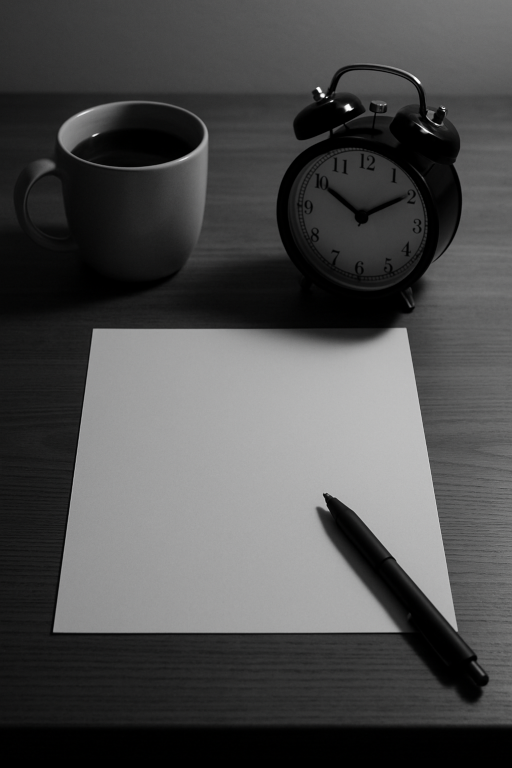
Seven hours. One blank page. Fifteen hundred words waiting to be born.
If you're staring down this challenge, you're not alone. Whether it's a looming deadline, a sudden assignment, or simply the reality of a writer's life, the pressure to produce quality prose or verses under time constraints is something every wordsmith faces eventually. The good news? Seven hours are actually more time than you think, if you know how to use it wisely.
This isn't about cutting corners or sacrificing your craft. It's about channeling your creative energy efficiently, understanding your process, and producing work you can be proud of when the clock runs out. Let's explore how to turn time pressure into productive momentum.
Hour One: The Foundation (Planning and Research)
The worst thing you can do with a ticking clock is start writing immediately. I know the urge is overwhelming, that blank page demands words, but resist. Your first hour is for building the architecture that will support everything that follows.
Begin by truly understanding your essay's purpose. What question are you answering? What argument are you making? Write your thesis statement at the top of your page, even if it's rough. This single sentence becomes your North Star, the point you'll navigate toward when you inevitably lose your way in the middle sections.
Next, spend thirty minutes on targeted research. Notice I said targeted. You don't have time to read three books and five academic papers. Instead, find two or three authoritative sources that directly address your topic. Take notes on specific quotes, statistics, or ideas that support your intention. If you're writing about literary techniques, for instance, you need concrete examples, and facts.
Hours Two Through Five: The Deep Work (Drafting)
This is where the real magic happens. You have four solid hours to transform your outline into prose, and the key is maintaining momentum without sacrificing quality.
Start with what I call the “ugly first draft" mindset. Your goal isn't perfection, it's completion. Write your introduction, knowing you'll probably rewrite it later. In fact, many professional writers compose their introductions last, once they fully understand what they've said in the body of their text.
Work through your outline point by point. Each main idea becomes a paragraph or section, typically 250-300 words. This means you're aiming for roughly five substantial paragraphs in your body, plus introduction and conclusion. Break this down further: if you write 375 words per hour, you'll hit 1500 words in four hours with time to spare.
Here's a technique that saves countless writers under deadline pressure: the paragraph burst method. Set a timer for 25 minutes and write one complete section without stopping. Don't edit, don't second-guess, don't delete. Just write. When the timer sounds, take a five-minute break, stretch, look away from the screen, let your mind rest. Then dive into the next section.
During these four hours, resist the temptation to polish as you go. That's editing brain trying to sabotage writing brain, and they cannot coexist productively. If you think of a better word or phrase, make a note in brackets [find better word here] and keep moving. Your momentum is precious; don't break it for minor improvements you can make later.
Pay attention to your energy levels. Most writers have a natural rhythm—perhaps you're sharpest in hour two and start flagging by hour four. Schedule your most complex arguments for your peak energy period. Save the more straightforward sections for when your brain is tired.
Remember that writing is thinking. As you draft, you'll discover ideas you didn't know you had. Your essay will evolve beyond your outline, and that's not just okay, it's the sign of a living, breathing piece of writing. Let it grow, but keep your thesis in sight. Every paragraph should connect back to that central argument, even if the path there surprises you.
Hour Six: The Refinement (Editing and Structure)
You've written your draft. It's messy, probably too long or too short, and certain sections make you wince. Perfect. That's exactly where you should be.
Hour six is for structural editing, the big-picture work that transforms a collection of paragraphs into a cohesive essay. Start by reading through the entire piece without stopping. Don't fix typos or awkward sentences yet. You're looking for larger issues: Does your argument flow logically? Are there gaps in your reasoning? Do you have enough evidence supporting each claim?
Check your paragraph transitions. Each section should lead naturally into the next, creating a sense of forward momentum. If you find yourself jumping abruptly from one idea to another, add a transitional sentence that bridges the gap. These connective tissues are what separate amateur essays from professional ones.
Now address your introduction and conclusion. Your introduction needs to hook readers while clearly stating your thesis. Consider opening with a compelling question, a surprising fact, or a brief anecdote that illuminates your topic. Your conclusion shouldn't simply restate what you've already said, it should synthesize your arguments and point toward broader implications. What does your essay mean for readers? Why should they care?
This is also the moment to check your word count. If you're short, look for places where you can deepen your analysis or add supporting examples. If you're over, identify redundant sections or tangential points that don't serve your central argument. Be ruthless. Every word should earn its place on the page.
For writers exploring different essay forms, remember that structure follows purpose. A persuasive essay builds toward a climax of evidence, while a reflective essay might circle around a central theme, approaching it from multiple angles. Make sure your structure matches your intent.
Hour Seven: The Polish (Line Editing and Proofreading)
You're in the home stretch. Your text has shape and substance. Now you're refining the language itself, making every sentence as clear, lyrical and powerful as possible.
Read your essay aloud. This single technique catches more problems than any other editing method. Your ear will detect awkward phrasing, repetitive words, and rhythm issues that your eyes might miss. When you stumble over a sentence while reading, that's your cue to revise it.
Look for common writing weaknesses. Are you using too many passive constructions? Search for "was" and "were" and see if you can convert those sentences to active voice. Are you hedging your claims with qualifiers like “perhaps," “maybe," or “somewhat"? Strike them. Are you relying on clichés or vague language? Replace them with specific, concrete details.
Pay special attention to your verbs. Weak verbs drain energy from your prose, while strong verbs propel readers forward. “She walked quickly" becomes “she rushed" or “she darted." “The book was interesting" becomes "the book captivated me" or “the book challenged my assumptions." These small changes accumulate into powerful prose.
Check your citations and formatting. Nothing undermines a well-argued text faster than sloppy references or inconsistent formatting. Make sure every quote is properly attributed, every source is cited, and your formatting matches the required style guide.
Finally, proofread for typos, spelling errors, and grammatical mistakes. Read backwards, sentence by sentence, to catch errors your brain might autocorrect when reading forward. Use spell-check, but don't rely on it exclusively, it won't catch “their" when you meant “there" or “affect" when you meant “effect."
The Writer's Mindset: Working Under Pressure
Beyond technique, writing under deadline requires the right psychological approach. Perfectionism is your enemy here. You're not writing a text or a poem that will define your career, you're writing a solid, well-argued piece within the constraints you have. That's not settling; that's being professional.
Embrace the constraints. Some of the most innovative creative work emerges from limitation. The seven-hour deadline forces you to trust your instincts, to write from your gut rather than overthinking every choice. Often, these time-pressured pieces have an energy and authenticity that more labored work lacks.
Stay hydrated and fed. Your brain runs on glucose and water. Keep both nearby. Take your scheduled breaks. A five-minute walk or stretch session isn't wasted time, it's an investment in sustained focus.