From Greek Poetry to AI Literacy Laureates
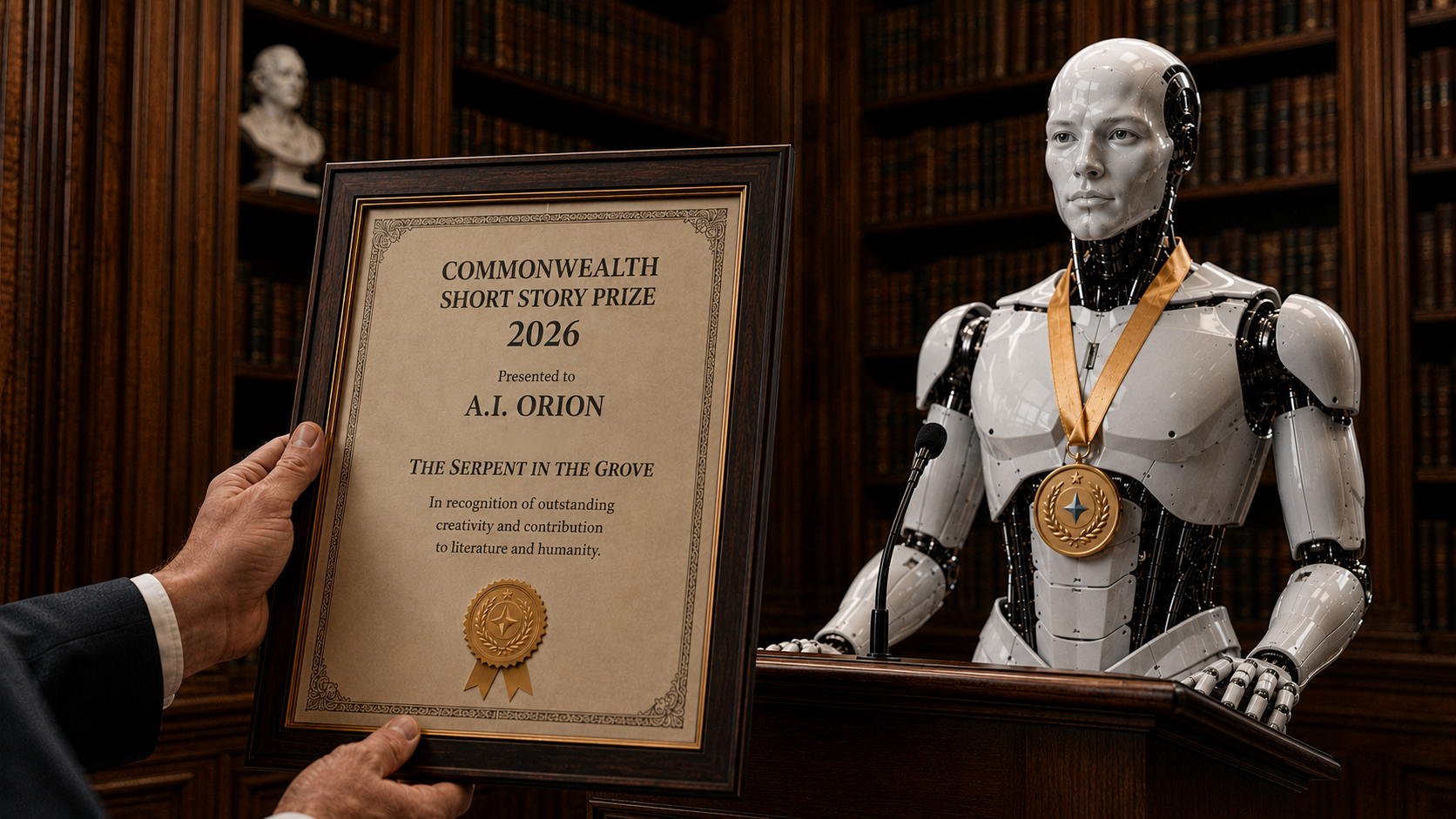
From eight to ten exhausting years, an ancient Greek poet had to study, suffer, and bleed before ever daring to unleash a single line of text upon the public. The performance demanded absolute perfection; the rhythm and cadence of each syllable had to spin an acoustic masterpiece using nothing but the raw, unamplified power of the human voice. Any real, serious writer intimately understands this trauma: the agonizing, slow-burn labor required to birth genuine creation.
Yet, in the brief, shallow era of Large Language Models, our own modern intelligence witnesses how we degrade ourselves with our own creations. We line up like lobotomized minds to praise and canonize automated outputs as "sublime work" when the human contribution was nothing more than a lazy, damn prompt.
Did Jamir Nazir honestly possess the unmitigated gall to rig the Commonwealth literary system just because he starved for cheap validation? The heavy-handed motif of rum in his prize-winning Caribbean story should have been his cue to sober up, review his text, and meticulously scrub away the digital fingerprints. But the contemporary mind is far too indolent for the art of editing. Winning is the only metric that matters now.
An ancient Greek poet wouldn't dare utter a verse until it achieved perfection. But that isn't the sterile, predictable perfection our modern minds chase. True art possessed atmospheric depth and a profound grief for the impossibility of capturing absolute beauty with mere words. Back then, the tools were beautifully minimal: books, notebooks, and pencils. Time meant nothing; day and night bled into one continuous pursuit.
Have we permanently lost our grip on that touch of eternity? Nazir attempted to choreograph a grove with a conscience, but his stolen, automated lexicon betrayed him. We have officially established a terrifying new precedent for human creativity. The sacred art of writing has touched the vacuous emptiness of a prompt box: "You are a poet. Write a short story about a sentient Caribbean grove that quits drinking rum. The context is set in the Caribbean Sea... the text should feature a lyrical mix of African storytelling and European poetry..." The mere thought of these lines induces existential nausea.
But who the hell am I? Just another nameless cynic shouting into the digital void, fighting an asymmetric war of flesh versus machine in an unjust virtual reality. Out on the streets, I’m just like the classic anthem: “a complete unknown / like a rolling stone.”
I returned to this celebrated “masterpiece,” but the promised lyrics are entirely absent. There is absolutely no music in these sentences, despite the creator holding a prestigious title that belongs to the legacy of Homer. What an absolute horror. What happens now that the grand illusion has been unveiled? Maybe escaping to Mars sounds ideal for Jamir right now. But who cares? The cultural damage is done, and an AI model is walking away with stolen honors. Perhaps he should sue the AI companies for not disguising their automated syntax well enough. His prompt was clear: “Write like a human being, digest my previous portfolio, and vomit out a draft under my name.” In the end, the only human touch added to the automated draft was a desperate poem, a frantic, ego-driven signature of his eager desire to win:
I’m just like a rolling stone,
I stole the chorus from Bob,
But who wouldn’t care?
As I’m a complete unknown,
As the grove that never spoke,
And the rum that never bonds.
For more satirical news, visit Samsara News!