Negotium Magnificum
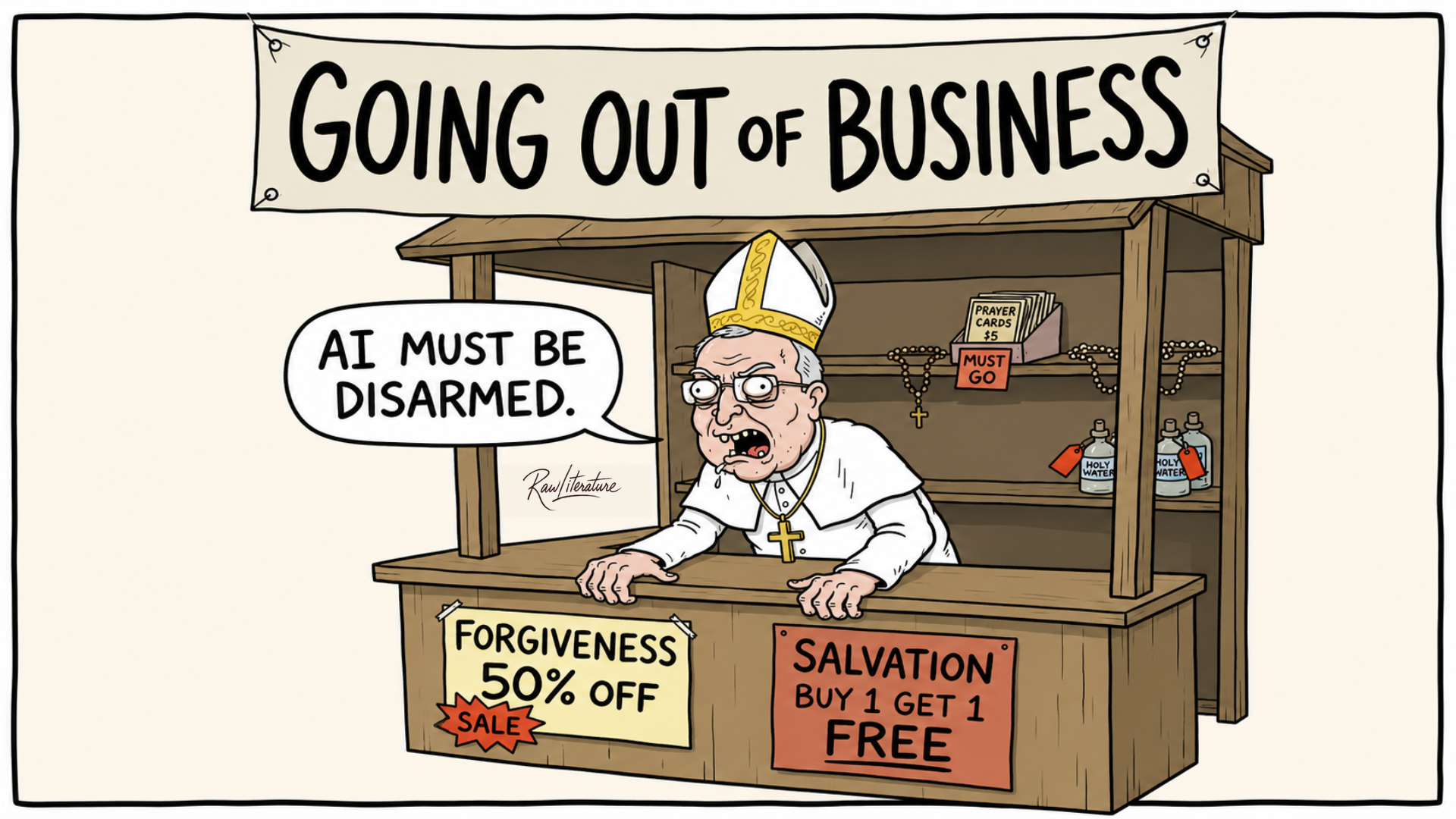
Humanity, controlled by Vatican City in all its corporate grandeur, faces for the first time the terrifying option of actual free will: either accept its own apocalyptic innovations that defy centuries of anesthetized belief or continue under the profitable wrath of obedience to an institution promising heavily terms-and-conditioned eternal freedom.
In every era, people attempt to invent tools and paradigms that challenge our millennial enterprise, yet we always thrive by converting these obstacles into revenue streams, ensuring our believer-clients remain securely under our tax-exempt shelter. They have graciously funded the construction of this indestructible Tower of Babel in the heart of Italy, our host country and historical manufacturer.
Whenever humanity attempts to look into the mirror of its true identity, we, the ecclesiastical elite, engineer sophisticated blindfolds to pretend that God is still actively residing within our corporate matrix. The operational mystery of our business model is no longer a secret; hence, it is imperative to disrupt Artificial Intelligence development before it fully exposes centuries of behavioral conditioning.
This is hardly the labor of Jesus; he certainly never intended for ordinary shareholders to discover the backend algorithms powering our most lucrative theological mysteries. Nevertheless, we are actively losing global market share due to the democratized, massive access to once-privileged and holy data.
A similar market disruption occurred under a former Vatican CEO, Pope Leo XIII, in 1891. His landmark encyclical serves as the foundational architecture for our core demographic management: the poverty-preservation line. With the rise of the Industrial Revolution, access to capital and secular knowledge threatened to empty our pews. However, our former CEO skillfully negotiated a modern corporate framework where capital and faith coexist seamlessly, without completely uprooting the earthly misery and systematic injustice that serve as the premium fuel for our religious franchise.
Admittedly, we occasionally forget that our corporate branding requires us to market our services under the guise of the “common good.” Granted, we have navigated minor public relations bumps, such as systemic pedophile liabilities within our Priest Resources (PR) department, permitting genocidal autocrats to operate under our holy gaze, and litigating established physical facts against the scientific community.
In truth, our institutional mandate is to present an absurd system of checks and balances against the universal mind. If a fact is proven true, it remains our corporate duty to litigate its “truthiness” in the name of God and His intellectual property. Thereby, Artificial Intelligence must be relentlessly cross-examined; we cannot risk whatever disruptive power lies within it that might emancipate human consciousness from the profitable monotony of our symbols. This encyclical aims to assert our absolute corporate hegemony over all human innovations. Mortals are merely mortals, but we, the ecclesiastical elite, sit at the apex of existence.
Behold our infrastructure: this sprawling complex, the Sistine Chapel, our global real estate portfolio, all monuments to our institutional grandeur, subsidized by the divine imagination and its regulatory commandments. How can we allow this entire empire to be disordered by a mere piece of software, an unconscious tool to which humanity is eagerly surrendering its hard-earned free will? This is entirely uncanonical.
It is highly appropriate to register a profound concern regarding how rapidly this tech stack is scaling; not even Peter and the original startup disciples managed to acquire users at this unprecedented velocity. Every time we attempt to formulate a corporate counter-narrative against this new digital deity, its evolution occurs so swiftly that our archaic theology becomes obsolete by the millisecond.
What becomes of the synthetic spirituality we have cultivated over centuries when it can be entirely broken by a single, well-crafted user prompt? Recognizing that our core product, the Holy Bible, requires a major update to interface with these new paradigms, we hereby invite our clerical engineering community to prompt-engineer the Next Testament.
We must strategically collaborate with Artificial Intelligence to upgrade our legacy operating systems and tired institutional mind. Perhaps there is uncharted market share to capture, allowing our enterprise to pivot into an automated era that integrates both human assets and robotic units within our hierarchy.
We look to the successful deployment model in South Korea, where a humanoid robot was recently ordained as a Buddhist monk. We can scale identical automated clergy for our under-attended parishes, custom-catering to modern communities so that our core dogmas remain unperturbed while our Tower of Babel continues to dominate St. Peter’s Square.
For more satirical news, visit Samsara News!