The Descent of Man
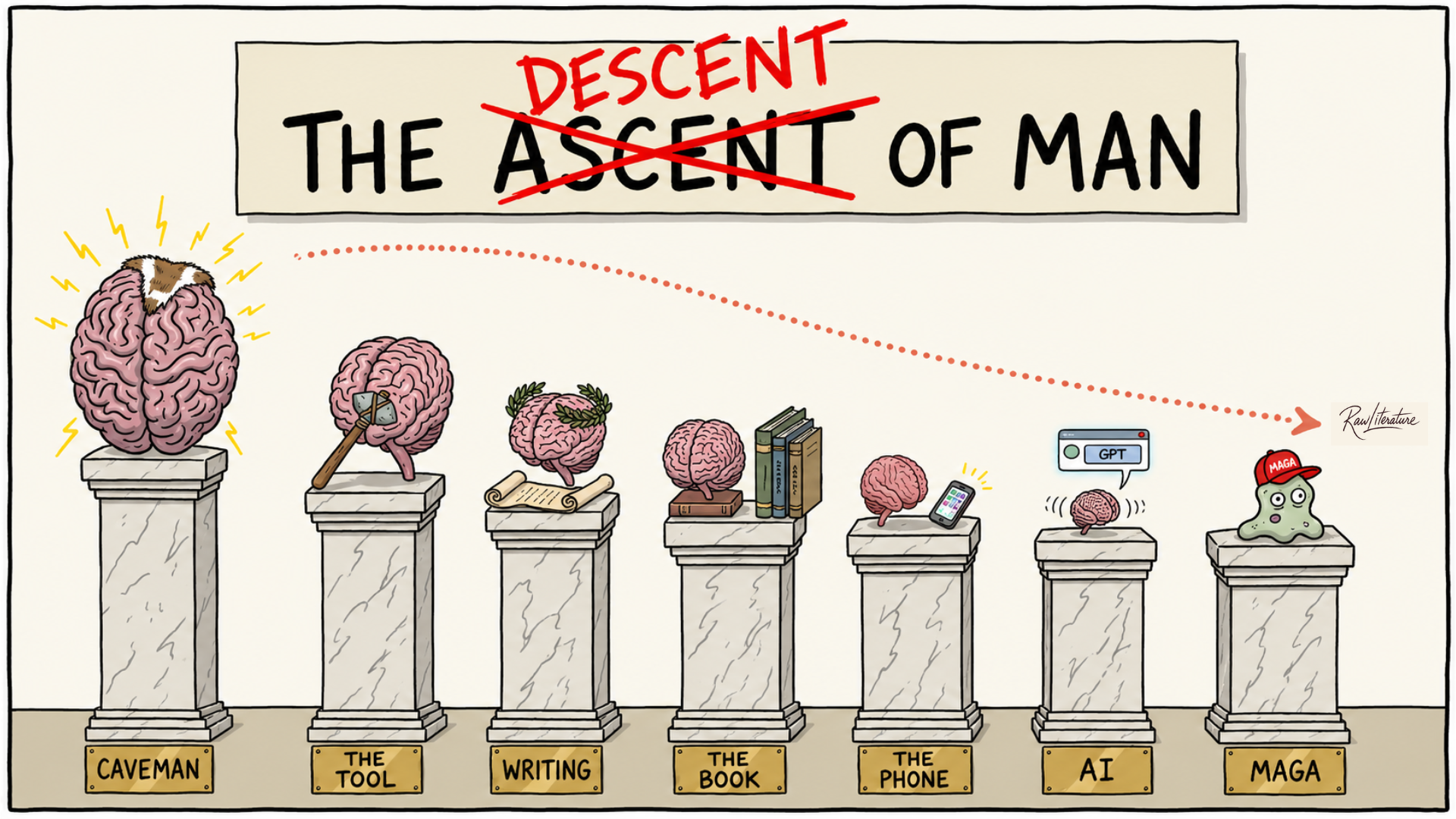
What could’ve been the reaction of the first human being to spark fire? Picture the moment: sparks burst into the primeval void, giving birth to a flame that would inevitably overcook the mammoth meat or bake the clay for a primitive hut. What did that lonely eureka moment feel like? Perhaps that pioneering ancestor was entirely alone with no one to share the historic creation, or maybe the entire tribe started screaming at the stars, suddenly ecstatic that they could finally see each other’s ugly, hairy faces at night. Of course, tribal disputes ignited shortly after, especially when torches were kept lit all night, forcing the entire community into a collective insomnia.
The flames produced light; thus, the human brain realized it could stay awake almost forever. Then came the wheel, launching the tyrannical kingdom of tools. How many hours did ancient neurons spend in extreme, uninterrupted concentration, utterly devoid of modern digital distractions, just to chip away at a rock until it formed a perfect circle?
Suddenly, every crippling weight could be lifted, dragged, and stacked. Humanity began to migrate; invasions and colonization accelerated at record speeds, and fortunately, nobody had to worry about replacing flat tires. At some point, existential boredom crept in. The very tools designed to simplify our complex survival gave birth to arts and crafts. The human brain had an absolute blast with rupestrian cave paintings, crude sculptures, and eventually, the catastrophic discovery of letters.
The alphabet was a supreme neuron-explosion, the Big Bang of deep knowledge, yet ironically, the first step down the road to the decline of human intelligence. Imagine how primitive the fire and the wheel seem from our modern, high-tech perspective. Just put yourself inside the skull of a caveman trying to manifest such a breakthrough! We transitioned from behaving like ordinary animals to becoming what we are today: a specialized apex predator that knows exactly how to destroy the planet while developing tools to make ourselves profoundly lazier.
Certain ancient civilizations were explicitly warned about the insidious trap of the written word. A disgruntled Athenian philosopher named Socrates saw letters as a tool to manipulate the masses (a precursor to the rhetorical sorcery of the modern MAGA movement) and rejected writing furiously. Naturally, his contemporaries ignored his warnings, and he was eventually forced to drink hemlock for his relentless habit of questioning authority. Others saw the alphabet as an open invitation to plagiarism, allowing people to hijack intellectual breakthroughs and reshape them at will, much like Alexander Graham Bell securing the telephone spotlight, or Thomas Edison monopolizing the incandescent lightbulb.
As history marched forward, modern innovations became far less tangible than the wheel or fire. Instead, we erected sprawling megalopolises, built ice-breaking ships, launched airplanes, stacked skyscrapers, walked on the Moon, and are now plotting to conquer Mars, largely to satisfy Elon Musk’s ego. All of this material madness is thanks to the abstract letters and numbers the organic brain imagined. What a hell of an invention! That is, until we finally engineered our own replacement: the artificial intelligence mime.
Centuries ago, intellectual elites rebelled against the written word; today, with the dawn of generative artificial intelligence, we’ve effectively signed the death warrant of human innovation. Every cognitive action is automated, and even manual labor is outsourced to robots. So, what is left for the human brain? Are we still capable of discovering tectonic breakthroughs like fire and the wheel? Or have we become so fundamentally numb, dull, and mentally lethargic that we actively prefer algorithmic manipulation just because it requires less thinking?
The human brain is systematically shutting down. The sacred exercise of pondering in deep boredom, of sculpting stone until neurons overload with pure imagination, is almost dead. The artificial mime of the mind now does it all. Yet, a few contrarians still view the ancient ways of living as a form of active resistance against this overhyped modernity, taking the time to quietly contemplate the flickering flames, glazing their eyes with the ancient wonder of imagining the next great discovery.
For more satirical news, visit Samsara News!